Durbin’s Brutal Rebuke Puts Blanche’s Trump Loyalty on Trial
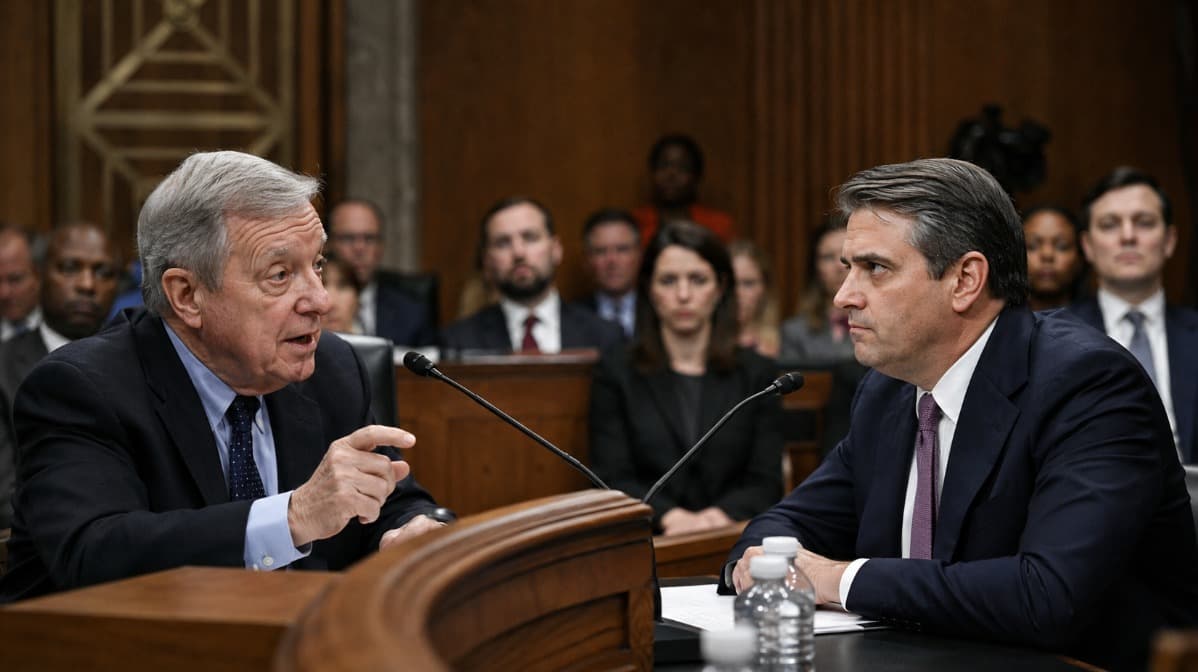
Senator Dick Durbin went straight to the issue that could define Todd Blanche’s confirmation battle: whether he can lead the Justice Department as an independent attorney general after years of serving as Donald Trump’s personal lawyer. During the Senate Judiciary Committee hearing, Durbin argued that Blanche’s record inside the department still looked less like impartial law enforcement and more like continued legal service to the president. The criticism was designed to make the hearing about something larger than individual controversies—whether Blanche’s first loyalty would be to the Constitution or to the man who selected him.
Durbin’s challenge carried extra force because Blanche entered the administration after representing Trump during his criminal cases. At one point during friendly questioning, Blanche even referred to himself in the present tense as Trump’s lawyer before quickly correcting the statement to say that he “was” his lawyer. Critics seized on the moment because it reinforced their concern that Blanche has never fully separated his former client relationship from his responsibilities as the nation’s acting chief law-enforcement officer. Blanche insists he can make decisions according to the law and has said his department is correcting political abuses he believes occurred under the previous administration.
The handling of the Jeffrey Epstein files became one of Durbin’s sharpest lines of questioning. The Justice Department’s releases were plagued by redaction problems, including material that exposed the faces or personal information of potential victims. Blanche acknowledged during the hearing that mistakes had been made, but he continued defending the department’s overall transparency. Durbin pressed him to commit to meeting personally with survivors of Epstein’s abuse within 30 days, but Blanche repeatedly declined to give a direct commitment during the hearing.
That refusal became politically costly almost immediately. Republican Senator Thom Tillis later announced that he would not vote to advance Blanche’s nomination unless Blanche met directly with Epstein survivors and their attorneys. Blanche eventually held the meeting, but survivor Dani Bensky said afterward that it felt like a “check-the-box” exercise designed to secure confirmation votes rather than rebuild trust. She said he interrupted survivors, avoided firm commitments and offered no credible new plan for pursuing accountability beyond Epstein and Ghislaine Maxwell.
Durbin also focused on the controversial IRS settlement signed by Blanche. The agreement emerged from Trump’s $10 billion lawsuit over the leaking of his tax records and included broad protections related to past tax audits for Trump, his family and affiliated businesses. Durbin questioned how the acting attorney general could approve language that appeared to release the president and connected parties from substantial liability while ordinary Americans remain fully subject to tax enforcement. Blanche said the agreement applied to past filings and did not place Trump above the law, but Durbin described the protections as unusually sweeping.
The same settlement originally created a $1.776 billion “Anti-Weaponization Fund,” financed through taxpayer money and intended to compensate people claiming they had been unfairly targeted by government investigations. The proposal collapsed after bipartisan criticism, and Blanche told senators it was no longer moving forward. Yet Republican and Democratic lawmakers remained skeptical because the administration had resisted providing a binding written guarantee that the fund could never return. A federal judge had already blocked its creation before another judge delivered a much broader condemnation of the entire IRS arrangement.
U.S. District Judge Kathleen Williams concluded that Trump’s IRS lawsuit had been used to obtain personal and political benefits from the government he controls. Her ruling said the opposing sides had not behaved as genuinely adverse parties and that the settlement attempted to provide legitimacy to immunity for Trump-linked individuals while earmarking billions of taxpayer dollars for grievances not defined by law. The judge barred the parties from relying on the settlement’s terms in future proceedings and sent her decision to disciplinary authorities in jurisdictions where Blanche and other senior officials hold law licenses.
That ruling gave Durbin a powerful foundation for arguing that Blanche’s problem was not simply political perception. A federal court had questioned the ethics and independence behind one of the most consequential agreements he approved. Blanche rejected what he called the judge’s insinuations and defended the department’s actions, but the controversy left senators asking whether he had protected the interests of the United States or negotiated a favorable outcome for his former client. Even Republican Senator John Cornyn remained concerned about whether parts of the agreement could protect Trump and his businesses from future scrutiny.
Blanche’s confirmation now depends on convincing skeptical Republicans that he can lead a Justice Department that serves the public rather than the president personally. Democrats are expected to oppose him, and the Judiciary Committee’s narrow margin means he cannot comfortably afford a Republican defection. Durbin’s remarks were memorable because they connected the Epstein releases, the IRS settlement, the abandoned fund and Blanche’s history as Trump’s lawyer into one central accusation: America needs an attorney general whose loyalty ends with the Constitution. Whether Blanche can overcome that perception may determine whether his nomination reaches the Senate floor at all.